
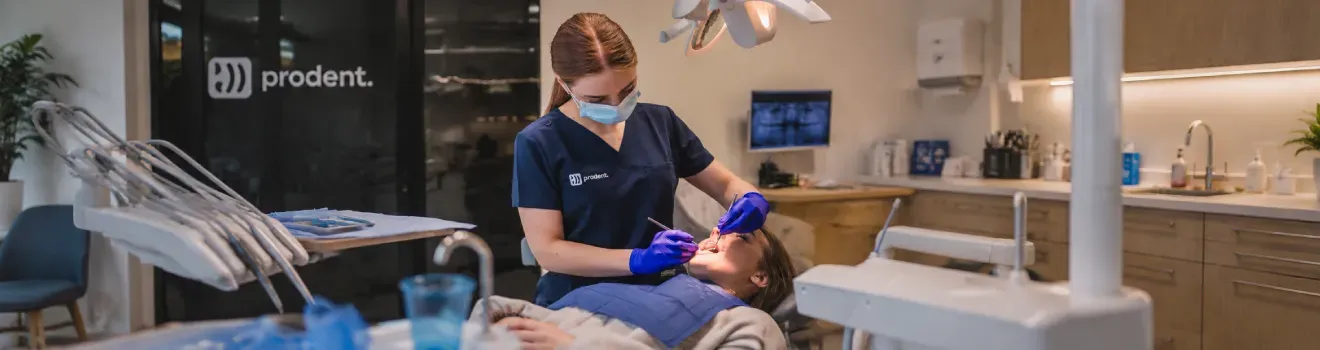
Preserve and repair your natural teeth
Restorative dentistry treats tooth decay and repairs damaged teeth. A filling replaces lost tooth structure; a carefully planned restoration can also improve the shape of a chipped or worn tooth. The choice depends on the amount of healthy tooth remaining, the bite and the condition of the pulp inside the tooth.
At ProDent we use tooth-coloured composite materials, including nanohybrid composites, selected to suit the restoration and shade. Deep decay may need a different approach, including a protective material such as Biodentine, treatment of the living pulp or root canal treatment.
Treatment options
| Treatment | When it may be considered |
|---|---|
| Composite filling | Restoring a cavity or replacing a damaged filling |
| ICON resin infiltration | Selected early enamel lesions without an established cavity |
| Pulp protection with Biodentine | Selected deep cavities where preserving the living pulp is possible |
| Composite bonding | Planned changes to the shape of front teeth, small gaps or chipped edges |
| Build-up before root canal treatment | Restoring enough tooth structure to isolate the tooth and continue treatment |
From examination to a finished filling
The dentist first examines the tooth and may recommend an X-ray. Local anaesthetic is used when needed; computer-controlled delivery is also available at the clinic.
We remove or manage decayed tissue according to the depth of the lesion and protect the pulp where appropriate. The tooth is then restored, shaped and polished, and the bite is checked. Teeth with extensive damage may need an onlay or crown rather than a large filling; see crowns and other restorations.
Deep decay and the living pulp
Decay close to the pulp does not automatically mean root canal treatment. In selected cases the dentist can use a protective material or vital pulp therapy to try to preserve living tissue. The diagnosis, symptoms and ability to seal and restore the tooth determine whether this is suitable. Further treatment may still be needed if the pulp does not recover.
Composite bonding
Bonding uses layers of tooth-coloured composite to reshape teeth. It can be considered for a small gap, chipped edge or asymmetry. It is different from simply filling a cavity and requires a plan for the overall shape and bite. Composite may stain, chip or need polishing and repair over time. Your dentist will explain how it compares with other options.
Early enamel changes
Some early lesions can be managed with fluoride, improved cleaning and dietary changes. ICON infiltration is an option for selected lesions. Once a cavity has formed, a filling or another restoration may be necessary.
When should you book?
Contact us if you notice sensitivity, a visible hole, a broken edge, food trapping around a filling or a change in an old restoration. White or brown marks also deserve an assessment. Decay does not always hurt, so do not wait for pain before arranging a check-up.
Looking after a restored tooth
Brush twice a day for about two minutes with fluoride toothpaste, and clean between your teeth daily. Mouthwash does not replace brushing or interdental cleaning. Ask your dentist or hygienist which products and techniques suit your mouth. Professional dental cleaning complements your home routine.
A new filling may feel sensitive for a short time. Contact the clinic if pain increases, the bite feels high or the tooth begins to hurt spontaneously, particularly at night.
Common questions
Does every area of decay need drilling?
No. Early changes without a cavity may be managed preventively or, in selected cases, with resin infiltration. An established cavity usually needs a restoration.
Does a filling hurt?
Local anaesthetic helps control pain during treatment. Tell the dentist if you feel discomfort so they can check the anaesthetic and adjust care.
How is bonding different from a filling?
A filling repairs lost structure, usually after decay. Bonding is planned to alter the shape or appearance of teeth, often at the front of the mouth. The techniques can overlap, but the purpose and scope differ.
When is root canal treatment needed instead?
It may be needed when the pulp has died or cannot be preserved. Inflammation alone does not decide the treatment: examination and diagnosis are essential.
See the restorative dentistry price list, book an appointment or call 570 400 405.
Further reading: NHS advice on tooth decay and the American Association of Endodontists’ position on vital pulp therapy.